CMDB Health Check

A two-week CMDB health baseline that shows which of your configuration items you can trust and which are guesses.

A CMDB health check shows which data you can trust

A CMDB health check is a fixed-scope review of your configuration management database (CMDB) that scores which configuration items (CIs) are reliable and which are guesses. Ours takes two weeks and ends with a report you can take to a change advisory board.

Most organisations don't question their CMDB until something breaks.

 Incidents take too long to resolve.

 Teams rely on guesswork instead of data.

 Systems behave unpredictably.

 Security breaches reveal governance problems.

By then, the cause usually sits in the configuration data behind the platform.

Engineer with a lanyard studying a screen in a data centre

What a CMDB health check tells you

A clear, objective view of how your configuration management is performing, based on the evidence in the CMDB itself.

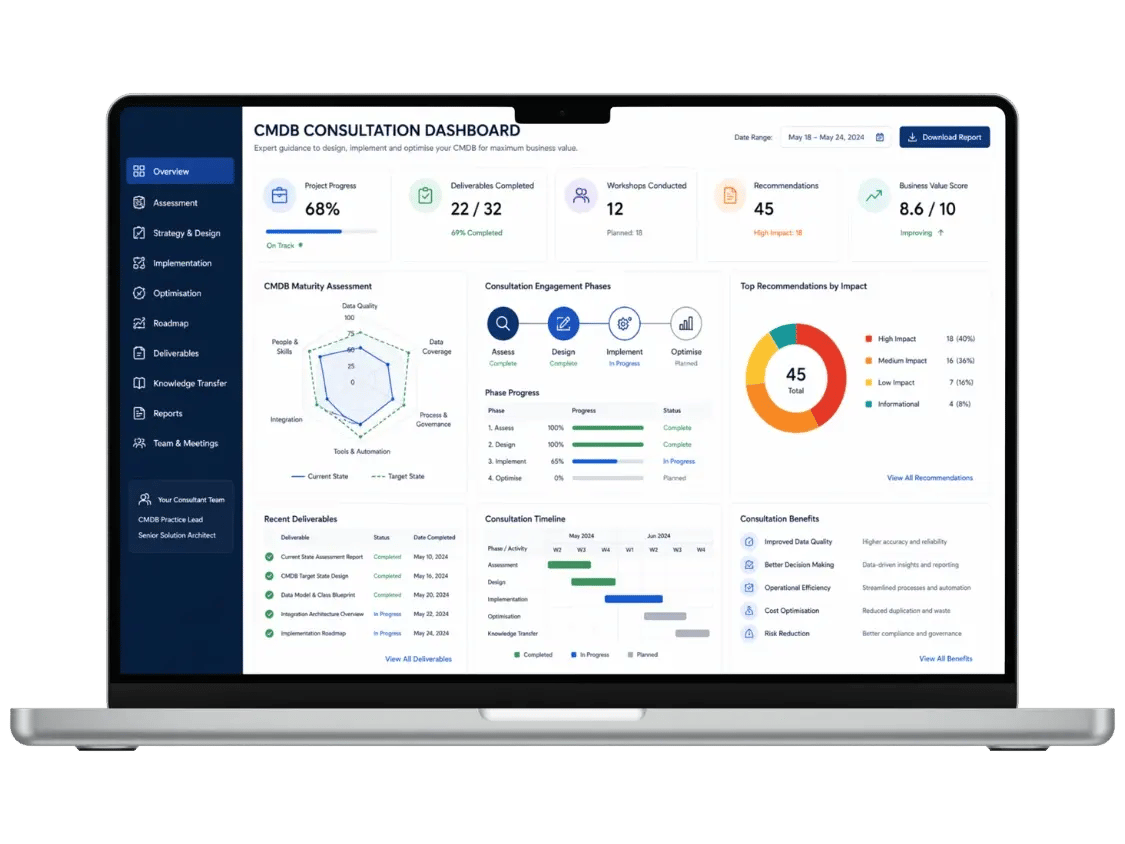
CMDB consultation dashboard overview

We assess whether your CMDB is: 

Many organisations discover that while their CMDB exists, it isn’t supporting the outcomes it was designed for. 

What we review

The health check focuses on the areas that directly affect performance. Each one is tested against the records in your CMDB, whatever the documentation claims:

Data quality and completeness

Are configuration items present, accurate, consistent and reliable?

Configuration item (CI) structure

Is your data model structured in a way that supports real-world operations?

Relationships and dependencies

Do you have a clear view of how systems connect and support services?

Discovery and integrations

Are automated tools correctly identifying and updating infrastructure?

Governance and ownership

Are there clear processes to maintain data accuracy over time?

What the health check finds

Most CMDB problems don't show at surface level. A health dashboard can show green while the underlying data is quietly wrong.

On one engagement, a client believed their Identification and Reconciliation Engine (IRE) was preventing duplicate configuration items. When we looked, there were over 50,000 open deduplication tasks that had never been addressed, the result of identification and reconciliation rules that had been misconfigured.

We look for the same class of problem on every health check:

  • Identification rules that create a new record instead of matching an existing one. For each class we work out which identification entry fires, and which requests fall through to the create-new path.
  • Reconciliation rules where two sources both claim precedence for the same attribute, so the value flips on alternate discovery runs.
  • Gaps between what discovery is scheduled to scan and what the network actually contains. A range with no schedule and a range with failing credentials look identical from inside the CMDB.
  • Processes with no named owner, so data quality degrades the moment nobody is watching.

These are usually the real explanation behind incidents and failed changes that get blamed on the platform. Our guide to what a CMDB health assessment involves covers the method in more detail.


Analyst at a desk with monitors, with a colleague working behind her

What you get after two weeks

The output is a scored view of which configuration items you can trust and which are guesses, with a prioritised plan for closing the gap.

You’ll receive:

Not ready to book yet? Try our free CMDB Health Scorecard first — fourteen questions, ten minutes.

We focus on the changes that will make the data more reliable and leave the rest alone.

Three colleagues talking through a laptop in an office overlooking a city

Why this matters

Most organisations don't question their CMDB until something breaks, and by then the cost has already landed somewhere else.

On one broadcast estate, a tag-based service mapping exercise let application owners tag each piece of infrastructure with only the application they considered primary, even where a server underpinned several. When a change took a critical server offline, no service map showed the other applications depending on it. Several went down alongside it, and a subsequent audit was what surfaced the missing map, not the change process.

Without a clear, verified picture of your CMDB:

 Operational problems continue

 Risk remains unmanaged

 Investment in ServiceNow underperforms

 The IT estate may be out of control

A health check exists to catch this before an audit or an incident does, not after.

CMDB health check: common questions

What is a CMDB health check?

A CMDB health check is a fixed-scope review that scores how reliable your configuration management database is. It separates the configuration items you can trust from the ones that are guesses, and traces each low score to specific records and causes.

How long does a CMDB health check take?

Ours takes two weeks. It needs some time from named people on your side, with the commitment agreed before we start and sized against your estate, and it doesn't need a change record or a maintenance window.

Does the health check change anything in ServiceNow?

No. It reads the CMDB and its rules and doesn't write to either. No reconciliation rules are changed, no configuration items are merged and no discovery schedules are touched while we look.

What do we receive at the end?

A scored report that shows which configuration items are trustworthy and which are guesses, with a prioritised list of what to fix first. It's written so it can go in front of a change advisory board without anyone translating it.

How is a health check different from a CMDB health dashboard?

The CMDB health dashboard reports scores that ServiceNow calculates from the data in the CMDB. A health check tests whether those scores can be believed, because a dashboard can show green while the underlying data is quietly wrong.

Can you fix what the health check finds?

Yes, if you want us to. We do that through design and implementation work, or by running the process for you as a managed service.

Want to know which of your configuration items you can trust? Book a meeting to arrange a two-week CMDB health check, or start with a CMDB diagnostic call.

Trusted by Organisations Worldwide

Structured Delivery Process

Structured approach. Clear outcomes. No overengineering

1. Assess & Diagnose

Comprehensive assessment of your current CMDB state, data quality, and automation maturity. 

2. Design for Clarity

Architect a CSDM-aligned data model and automation framework tailored to your environment. 

3. Implement & Automate

Build automated discovery, data validation, and self-healing processes for sustained accuracy. 

4. Govern & Optimise

Establish governance frameworks, KPIs, and continuous monitoring to maintain CMDB health. 
Trusted By Fortune 500 Enterprises | ServiceNow Certified Experts

Ready To Gain Control & Clarity?

Partner with specialists who deliver accurate, automated, and resilient CMDBs for enterprise organisations.